


A Man Thought He Found a Stray Kitten. Scientists Discovered a New Wild Cat in Bolivia
Scientists Have Just Identified a New Wild Cat Species — and It Was Hiding in Plain Sight
For years, a small spotted cat lived in Bolivia without anyone realizing that it represented something extraordinary.
To local people, it was simply a little wild-looking cat known as a tilcayo.
To scientists, at first, it appeared to be another member of a group of small South American felines known as tiger cats.
But something did not quite fit.
The animal was smaller than a typical domestic cat. Its coat was covered with distinctive dark rosettes. Its appearance was familiar enough to suggest that scientists had seen cats like it before, yet different enough to raise questions.
Then researchers looked at its DNA.
The result changed the story completely.
Scientists have now formally described Leopardus tilcayo, a previously unrecognized wild cat from Bolivia's Yungas cloud forests. The discovery, published in the journal Current Biology in September 2026, represents the first newly described living cat species in more than a century.
The story is remarkable for another reason.
This was not a mysterious animal discovered deep inside an unexplored jungle after a dramatic expedition.
At least part of the story began with what appeared to be an ordinary stray kitten.
A local man found the young animal near a forest and initially believed he had found a domestic cat. He eventually realized that the animal was wild and brought it to the Senda Verde wildlife sanctuary in Bolivia.
Years later, scientists studying the cat discovered that they were looking at something that had never been formally recognized by science.
The new species is small, elusive and adapted to one of South America's most spectacular environments.
And there is an important warning hidden inside the discovery.
The Yungas forests where the tilcayo lives are under pressure from deforestation, agriculture, fires and mining.
Scientists are therefore facing a remarkable situation: they have just described a new species, but they still know very little about how many of these animals exist in the wild.
Meet Leopardus tilcayo
The new species has been given the scientific name Leopardus tilcayo.
Its common name is the Tilcayo tiger cat, while local communities have used the name "tilcayo" for the animal.
The cat belongs to the genus Leopardus, which includes several of South America's small wild cats.
Despite belonging to a group that scientists have studied for generations, the tilcayo remained unrecognized as a separate species.
That is exactly what makes the discovery so fascinating.
The animal does not look like a completely unfamiliar creature.
It looks like a tiny wild cat.
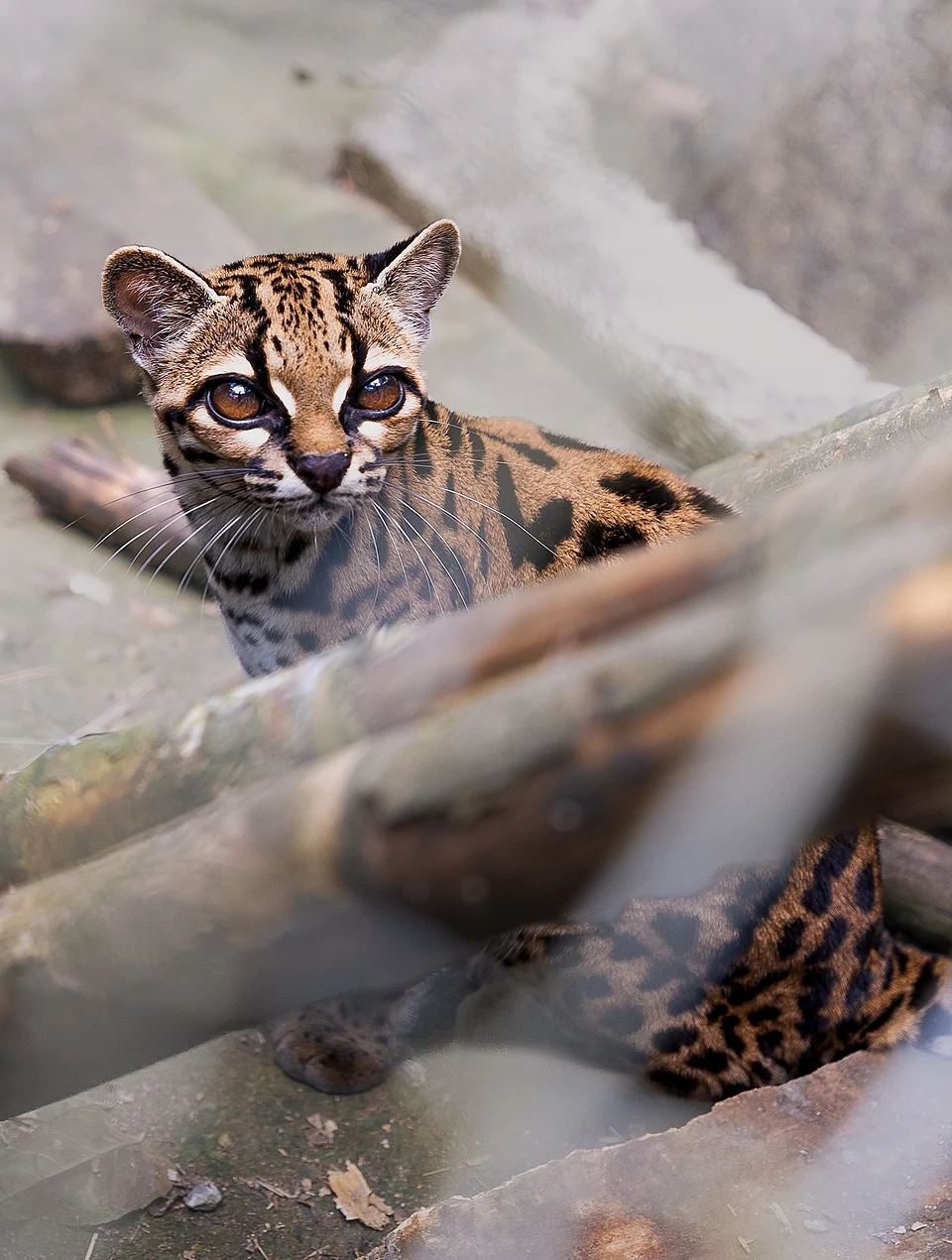
It has a slender body, rounded ears, a short-looking muzzle and a light brown coat covered with irregular dark rosettes.
But its small size is striking.
Researchers report that the animal measures roughly 46 centimeters from head to body and weighs approximately 1.4 kilograms, or about three pounds. That makes it smaller than the average domestic cat.
Yet its appearance alone was not enough to establish that it was a new species.
That required genetics.
And genetics revealed a much older story.
Researchers estimate that the lineage leading to Leopardus tilcayo separated from its closest tiger-cat relatives around 1.4 million years ago.
In other words, this was not a recently isolated population that had only just begun changing.
Its evolutionary history stretches back deep into the Ice Age.
The scientists simply had not recognized its identity until now.
The "Stray Kitten" That Wasn't a Stray
One of the most unusual parts of the story is how the animal first came to human attention.
The story goes back to the middle of the 2010s.
A local family encountered a small spotted cat in the Yungas region. Like many people might have done when seeing a tiny feline, they initially believed it could be a domestic kitten.
The animal was eventually brought into human care.
But it did not behave like an ordinary house cat.
After roughly a year, the family recognized that the animal was wild and would be better suited to a wildlife sanctuary.
The cat eventually ended up at Senda Verde, a wildlife refuge in the Yungas region of Bolivia.
That was when the scientific story really began.
Bolivian biologist and National Geographic Explorer Paola Nogales-Ascarrunz became interested in the animal.
At first, she believed it was probably a tiger cat that had already been described by science.
That assumption would have been perfectly reasonable.
The genus Leopardus contains several small, spotted cats whose appearances can overlap considerably.
But the more Nogales-Ascarrunz looked at the animal, the more questions emerged.
Its appearance did not completely match existing descriptions.
The pattern of its coat was unusual.
Its rosettes appeared larger than those illustrated in descriptions of related tiger cats.
Its geographical location was also significant.
The animal came from Bolivia's Yungas — an environment that is very different from some of the areas where previously recognized tiger cats had been studied.
Instead of simply assuming that the animal belonged to an existing species, researchers began asking a more interesting question:
What tiger cat actually lives here?
That question eventually led to an international genetic investigation.
Why Scientists Did Not Recognize It Immediately
At first glance, discovering a new cat species sounds like something that should be relatively straightforward.
After all, cats are among the most recognizable groups of mammals on Earth.
Lions, tigers, leopards, jaguars, cheetahs and domestic cats are familiar to millions of people.
But small wild cats can be a completely different story.
Scientists describe tiger cats as cryptic species.
That does not mean that the animals are literally invisible.
It means that closely related species can look extremely similar while being genetically distinct.
Two animals can have similar body sizes, similar fur and similar markings while representing separate evolutionary lineages.
This creates a problem for traditional species identification.
If scientists only look at an animal's external appearance, they may classify it as something already known.
DNA can reveal a different story.
That is exactly what happened with the tilcayo.
The researchers did not simply compare one cat with a photograph in an old book.
They conducted a much larger genetic investigation.
Their study examined 38 tiger cats from different parts of South America, including modern animals and historical museum specimens. Eight museum specimens were incorporated into the analysis.
The results were surprising.
The animals traditionally treated as tiger cats did not represent one single species.
The genetic data showed five distinct tiger-cat species.
One of those lineages was the previously unrecognized Bolivian species.
Leopardus tilcayo was no longer simply an unusual-looking tiger cat.
It was a distinct branch of the evolutionary tree.
A Discovery Hidden Inside a Bigger Discovery
The story of Leopardus tilcayo is therefore slightly more complicated than the headline "new cat species discovered in Bolivia" suggests.
Scientists were not simply studying one strange animal.
They were re-examining an entire group of South American cats.
Their genomic analysis revealed that what had traditionally been treated as a single tiger-cat species actually contained several genetically distinct lineages.
The newly described Leopardus tilcayo was one of them.
Researchers also identified a new subspecies in Peru's Yungas, named Leopardus tigrinus antisuyo.
The name "antisuyo" refers to Antisuyu, one of the regions of the Inca Empire associated with the eastern Andes.
That means the 2026 study has implications beyond one species.
It changes how scientists understand the evolutionary history of small spotted cats across South America.
It also raises questions about how many other populations might have been grouped together incorrectly in the past.
A species can remain hidden not because nobody sees it, but because nobody realizes what they are looking at.
That is one of the most important lessons of the tilcayo discovery.
A Cat Smaller Than Many House Cats
One of the details that makes Leopardus tilcayo so visually appealing is its size.
This is not a large predator.
It is not remotely comparable in size to a jaguar or puma.
The tilcayo is a tiny wild cat.
Researchers describe it as roughly 46 centimeters long from head to body, with a weight around 1.4 kilograms.
For comparison, many domestic cats weigh several kilograms.
That means a fully grown tilcayo can look surprisingly small beside an ordinary pet cat.
But its appearance gives away its wild nature.
The coat is light brown and marked with dark, irregular rosettes.
Its body is slender.
The ears are rounded.
And its facial features give it the unmistakable appearance of a miniature wild predator.
The rosettes are especially interesting.
Researchers noticed that the markings appeared different from those commonly associated with related tiger cats.
That difference helped stimulate further investigation.
Yet markings alone would never have been enough to establish a new species.
The decisive evidence came from its genome.
What Does the Tilcayo Eat?
Here the scientific story becomes much more mysterious.
Researchers still know surprisingly little about the everyday life of Leopardus tilcayo.
Scientists have examined scat samples, and remains of small rodents suggest that rodents may form part of the animal's diet.
Camera-trap observations also suggest that the species may be more active at night.
But these are early clues rather than a complete behavioral profile.
We do not yet have the kind of detailed ecological information available for better-studied animals.
Scientists still need to learn:
- how large its home range is;
- exactly what it eats;
- how often it hunts;
- whether it is primarily nocturnal;
- how it communicates;
- how it chooses territories;
- how it reproduces;
- how many kittens females normally have;
- how long it lives;
- and how large the wild population actually is.
That is remarkable when you consider that the species has probably existed for more than a million years.
The cat was not new.
Our knowledge of the cat was new.
The Yungas: A Perfect Place to Hide
To understand why Leopardus tilcayo could remain scientifically overlooked, it helps to understand its home.
The animal is associated with the Yungas, a mountainous region on the eastern slopes of the Andes in Bolivia.
The Yungas are famous for dramatic landscapes.
Clouds often hang over the mountains.
Moisture feeds dense vegetation.
Steep terrain creates a complicated patchwork of forests, valleys and slopes.
The region forms an ecological transition between the high Andes and the Amazon basin.
This combination makes the Yungas exceptionally rich in biodiversity.
It also makes field research difficult.
Dense vegetation can hide animals.
Steep mountains make access challenging.
Many species are active at night.
Small cats can move through forests without being noticed by people.
A tiger cat that weighs only around 1.4 kilograms can disappear into the vegetation remarkably easily.
That means the phrase "discovered in Bolivia" can be misleading if people imagine scientists walking into a completely unexplored jungle and suddenly finding an unknown animal.
The animal was already there.
Local people knew cats like it existed.
What scientists discovered was that this particular population represented a distinct species.
Local Knowledge Came First
There is another fascinating part of the story that deserves attention.
The name tilcayo did not come from a laboratory.
It came from local communities.
People living in the region already had a name for cats like this.
Scientists later adopted that local name for the species' scientific designation.
This is an important reminder that scientific recognition and local knowledge are not the same thing.
An animal can be familiar to people living alongside it while remaining unknown to formal science.
For generations, local communities may observe animals, recognize their behavior and distinguish them from other species.
Scientists, meanwhile, may only encounter those animals later through field research, museum collections, genetics or conservation programs.
In the case of Leopardus tilcayo, local knowledge helped preserve the identity of the animal even before science formally recognized it.
The cat was not "new" to the forest.
It was new to scientific classification.
The DNA That Changed Everything
The most important evidence came from genetics.
Researchers sequenced genomes and compared them with genetic material from tiger cats collected across South America.
The study incorporated modern samples as well as historical material from museum specimens.
This allowed scientists to compare animals from different regions and different periods.
The resulting evolutionary picture was much more complicated than previously thought.
Instead of one broad tiger-cat group, the researchers identified five genetically distinct species.
The Bolivian lineage stood apart.
Genetic analysis suggested that Leopardus tilcayo separated from other tiger-cat lineages approximately 1.4 million years ago.
That number is difficult to imagine.
One million years ago, humans were living very different lives.
Our species' evolutionary history itself looked dramatically different.
The ancestors of today's tilcayo had already begun following their own evolutionary path.
For hundreds of thousands of generations, that lineage continued changing independently.
Yet modern science only formally gave it a name in 2026.
What Does "New Species" Actually Mean?
The phrase "new species" can sometimes create confusion.
It does not mean the animal suddenly appeared this year.
It does not mean that the species evolved recently.
And it does not necessarily mean that no human had ever seen the animal before.
Instead, it means that scientists have now formally recognized and described a distinct evolutionary lineage.
In the case of Leopardus tilcayo, the evidence indicates that its lineage has been separate from related tiger cats for around 1.4 million years.
The scientific description gives that lineage a formal identity.
That matters because scientific names allow researchers around the world to communicate about the same organism.
Once a species is formally recognized, scientists can begin asking much more precise conservation questions.
How many exist?
Where do they live?
Are populations connected?
Are they declining?
What habitats do they require?
What threats do they face?
Those questions are particularly important in the Yungas.
Scientists Still Don't Know How Many Tilcayos Exist
Perhaps the most concerning part of the discovery is also one of the biggest scientific unknowns.
Researchers do not yet have a reliable population estimate for Leopardus tilcayo.
The species has been documented through live individuals and a small number of camera-trap records.
The researchers have emphasized that their information is still limited.
Reuters reported that the team had examined two live individuals, alongside a small number of camera-trap records.
One of those animals is a 10-year-old male living at Senda Verde.
A female has also been studied and was released into the wild after being rescued, according to reporting on the research.
This is an extraordinary situation.
Scientists now have enough evidence to say that the species exists.
But they do not yet know how many wild animals there are.
They do not know the full geographical range.
They do not know whether the population is stable.
And they do not know whether the species is common in remote areas or genuinely extremely rare.
That uncertainty makes conservation assessment difficult.
Why the Discovery Could Be Bad News
Finding a new species normally sounds like nothing but good news.
But discovering a new species can also reveal a conservation problem.
Before scientists recognized Leopardus tilcayo as a separate species, populations belonging to this lineage could effectively disappear inside broader categories.
If several distinct species are grouped together, the combined population can appear healthier than any individual lineage actually is.
Imagine five different species being counted as one.
The total number might look relatively large.
But one of those five species could be extremely rare.
That is why taxonomy matters for conservation.
The researchers have shared their findings with the International Union for Conservation of Nature, or IUCN, which maintains the Red List of threatened species.
The tiger-cat lineages are expected to be reassessed separately as more information becomes available.
It is therefore too early to state a definitive global conservation category for Leopardus tilcayo based solely on the initial discovery.
More field research is needed.
But scientists already have reasons to be concerned.
The Yungas Are Under Pressure
The Yungas forests are not an untouched paradise.
They face several human-driven pressures.
Researchers have identified threats including:
Deforestation
Forest clearing reduces habitat and can divide animal populations into smaller isolated areas.
Agricultural expansion
As agriculture expands into forested areas, wildlife loses habitat and movement corridors.
Human-caused fires
Fires can destroy vegetation and transform ecosystems that took decades or centuries to develop.
Mining
Mining activity can disturb habitats and contribute to landscape fragmentation.
These pressures matter even more for a species whose distribution may be naturally limited.
If Leopardus tilcayo depends on particular forest conditions, losing those habitats could have serious consequences.
And because scientists only recently recognized the species, they are still trying to determine exactly where its strongest populations are.
Why Camera Traps Matter
For a small, elusive wild cat, traditional wildlife surveys can be extremely difficult.
Researchers cannot simply walk through the forest and expect to see one.
This is where camera traps become valuable.
Motion-triggered cameras can operate continuously, day and night, without requiring a researcher to stand nearby.
They can capture animals that are otherwise almost impossible to observe.
For Leopardus tilcayo, camera traps are particularly important because researchers need to establish whether the species is widespread or restricted to small pockets of suitable habitat.
They can also help reveal:
- activity times;
- habitat preferences;
- movement patterns;
- interactions with other species;
- possible breeding behavior;
- and changes in population over time.
National Geographic images released alongside the discovery show researchers installing camera traps in the Yungas in an effort to document the species in its natural environment.
This is likely to become one of the most important tools for understanding the newly recognized cat.
A Species Can Be Hidden in Plain Sight
The tilcayo story is a perfect example of a phenomenon that occurs throughout biology.
Scientists sometimes discover organisms not because they were completely unknown, but because their identity was misunderstood.
A population may be classified as:
- a subspecies;
- a regional variation;
- an unusual individual;
- or simply part of a widespread species.
Modern genetics can overturn those assumptions.
This has happened repeatedly in zoology.
DNA has revealed hidden diversity among frogs, bats, rodents, insects, birds and other groups.
The discovery of Leopardus tilcayo demonstrates that even charismatic mammals are not necessarily fully understood.
People often imagine that scientists have already discovered all the world's mammals.
That is not true.
New mammals continue to be formally described.
What makes this discovery unusual is the type of animal involved.
A new small wild cat is much harder to imagine than a new insect or microscopic organism.
Cats are familiar.
There are relatively few species compared with many other animal groups.
And yet one more has now been added to the list.
The First New Living Cat Species in More Than 100 Years
The discovery has attracted so much attention because of its place in feline scientific history.
Researchers describe Leopardus tilcayo as the first new living cat species formally described in more than a century.
That makes the announcement historically significant.
The last century has seen enormous advances in zoology.
Scientists have gained access to:
- DNA sequencing;
- satellite imagery;
- remote sensing;
- camera traps;
- drones;
- geographic information systems;
- museum databases;
- automated species recognition;
- and increasingly sophisticated genomic analysis.
Yet even with all these technologies, a small wild cat remained scientifically misidentified.
The discovery is therefore a reminder that technological progress does not eliminate biological mysteries.
Sometimes the mystery is sitting right in front of us.
The Importance of Museum Collections
One of the less visible heroes of this discovery is the natural-history museum.
Scientists did not rely only on living animals.
They also used historical museum specimens.
The study incorporated eight museum specimens as part of the genetic investigation.
Museum collections preserve biological information long after an individual animal has disappeared from the wild.
A specimen collected decades ago can become scientifically valuable when new questions arise.
Modern DNA techniques can sometimes extract genetic information from old material.
That allows scientists to compare today's animals with historical populations.
It can reveal evolutionary relationships that were impossible to detect when the specimens were originally collected.
In the tilcayo study, historical material helped researchers understand the broader diversity of tiger cats across South America.
The lesson is simple:
A museum specimen is not merely an old animal preserved in a collection.
It can be a time capsule.
The Cat That Changed the Tiger-Cat Family Tree
Before the new research, scientists already knew that tiger cats were genetically complicated.
But the new study provides much stronger evidence that the group contains several separate species.
The researchers identified five genetically distinct tiger-cat species.
That means the scientific picture of these small cats has become much more detailed.
The newly recognized Bolivian species occupies its own branch.
The discovery therefore changes not only the name of one cat but our understanding of the evolutionary history of an entire group.
This is why taxonomy can be so important.
A scientific name may look like a small detail.
But behind that name can be millions of years of evolutionary history.
When scientists recognize a separate species, they are effectively saying:
This lineage has its own evolutionary story.
And the tilcayo's story appears to be exceptionally old.
Why the Name Tilcayo Matters
Scientific names often have fascinating origins.
Some honor scientists.
Others describe physical characteristics.
Some refer to locations.
In this case, the name comes from local usage.
The word tilcayo was already associated with these cats in local communities.
Scientists retained the local name when formally describing the species as Leopardus tilcayo.
That gives the scientific name a direct connection to the landscape where the species lives.
It also reflects a broader principle in modern conservation biology: local knowledge can be extremely valuable.
People living in biodiversity-rich regions may have generations of experience observing wildlife.
They may know which animals appear at night, which forests they prefer and what local names distinguish similar-looking species.
Science can add genetic analysis and formal classification.
Local communities can provide observations accumulated over decades or centuries.
When those sources of knowledge meet, surprising discoveries can emerge.
The Cat Was Not Waiting to Be Discovered
There is something almost poetic about this story.
The species was not sitting in the forest waiting for scientists to give it a name.
It had already been living in the Yungas for an enormous amount of time.
It was hunting.
Moving through vegetation.
Avoiding predators.
Raising young.
Interacting with its environment.
It simply did not have a scientific name.
The distinction matters.
Scientific discovery is often about changing our understanding rather than changing reality.
Leopardus tilcayo existed long before the paper in Current Biology.
September 2026 simply became the moment when the scientific community formally recognized its distinct identity.
What Scientists Need to Discover Next
The initial description is only the beginning.
The next stage will be field research.
Researchers need to determine the species' actual distribution.
They need to know whether Leopardus tilcayo occurs across large parts of the Bolivian Yungas or only in particular forest fragments.
They also need to determine population density.
A species can have a relatively large range but still be rare.
Alternatively, it could be locally common in places that scientists have not yet surveyed.
Camera traps may help answer those questions.
Genetic sampling could also provide information about population connectivity.
Researchers may eventually be able to identify separate populations and determine whether habitat fragmentation is preventing animals from moving between them.
That information will be crucial for conservation planning.
Could the Tilcayo Be Endangered?
It is tempting to immediately call a newly discovered species endangered.
But scientifically, caution is necessary.
A formal conservation assessment requires information about population size, range, trends and threats.
At the moment, researchers simply do not know enough about Leopardus tilcayo to provide a complete picture.
What they do know is concerning.
The species appears to be associated with the Yungas.
The Yungas face habitat loss and other pressures.
And the species has only recently been recognized, meaning its true distribution and abundance remain uncertain.
The research team has communicated the findings to the IUCN for consideration in future assessments.
That assessment process will be important.
If the species is found to have a very small population or severely fragmented habitat, its conservation status could become a major concern.
But scientists need evidence before assigning a definitive category.
Why Discovering a New Species Can Actually Make It More Vulnerable
There is an uncomfortable paradox in wildlife conservation.
A species may become more visible to the world when scientists discover it.
But that increased attention can also reveal how little is known about it.
Before the tilcayo received a scientific name, there was no separate conservation category specifically focused on the species.
Researchers may have been studying tiger cats broadly.
After the discovery, the questions become more precise.
Where does the tilcayo live?
How many are there?
Are populations declining?
Which areas are most important?
Does it cross agricultural landscapes?
Can it survive in fragmented forest?
Does it depend on mature cloud forest?
The answers could eventually determine conservation priorities.
In that sense, naming the species is only the first step.
The real challenge is protecting it.
What Makes Cloud Forests So Special?
Cloud forests are among the world's most biologically fascinating ecosystems.
They exist in mountainous regions where moist air interacts with cooler elevations.
Clouds and mist can remain close to the forest for long periods.
Plants are adapted to high humidity.
Trees can be covered with mosses, lichens, bromeliads and epiphytes.
The result is an environment that looks almost unreal.
For wildlife, cloud forests provide complex layers of habitat.
Animals can move through:
- the forest floor;
- shrubs;
- tree trunks;
- branches;
- and dense vegetation.
For a small predator like the tilcayo, this complexity can provide cover while hunting.
It can also make the animal extremely difficult for humans to observe.
That combination of dense habitat and mountainous terrain may have helped the species remain scientifically obscure.
A Tiny Predator With a Huge Scientific Story
The tilcayo may be physically small, but its discovery has implications far beyond the size of the animal.
A 1.4-kilogram cat has forced scientists to rethink the diversity of an entire group.
It has also demonstrated that evolutionary history can remain hidden even among well-known mammals.
The discovery illustrates why biodiversity research remains important.
Scientists cannot protect what they do not know exists.
If a population is incorrectly classified, its conservation needs may also be misunderstood.
This is especially relevant when habitats are changing rapidly.
A species could potentially decline for years before scientists even realize that it is distinct.
That is why taxonomy, genetics and field ecology are closely connected.
The Human Side of the Discovery
There is also something unusually relatable about the story.
Someone found a tiny cat.
It looked unusual.
But instead of becoming an internet curiosity or a family pet, it eventually reached a wildlife sanctuary.
A biologist noticed that something did not quite match.
The questions grew.
Researchers collected genetic data.
Museum specimens were examined.
Camera traps were deployed.
And eventually a scientific paper revealed that the animal represented a new species.
This is a reminder that major scientific discoveries do not always begin with spectacular expeditions.
Sometimes they begin with a simple observation:
This animal doesn't look quite right.
Curiosity does the rest.
The Role of Paola Nogales-Ascarrunz
Bolivian biologist Paola Nogales-Ascarrunz played a central role in bringing attention to the unusual cat.
As a National Geographic Explorer and researcher working on Bolivian felids, she was in a position to notice the differences that might otherwise have been overlooked.
When she first encountered the animal, she did not immediately assume it represented a new species.
Instead, she compared it with what was already known.
That is an important part of scientific work.
Scientists do not normally begin with the conclusion "this must be a new species."
They begin with a question.
What is it?
How does it compare with known animals?
Does its appearance fit?
Does its geography fit?
Does its DNA fit?
Only after multiple lines of evidence agree can a new species be formally recognized.
In this case, the evidence eventually became compelling.
The Science Behind Species Discovery
Modern species identification increasingly combines multiple types of evidence.
For Leopardus tilcayo, researchers used several.
Morphology
Scientists examined the animal's physical appearance, including size, coat pattern and other characteristics.
Geography
The location in Bolivia's Yungas was important because species often have specific geographic distributions.
Genetics
DNA revealed that the Bolivian animals formed a distinct evolutionary lineage.
Genomics
Whole-genome information provided much deeper comparisons than simple DNA markers.
Museum specimens
Historical material allowed researchers to compare present-day and older examples.
Camera traps
Field cameras provided evidence of the animals in their natural environment.
No single piece of evidence tells the entire story.
Together, they created a much stronger case.
A 1.4-Million-Year-Old Secret
Perhaps the most astonishing number in the entire story is 1.4 million years.
That is approximately how long researchers estimate the tilcayo lineage has been separate from other tiger cats.
Imagine what the Yungas looked like that long ago.
The Andes were already imposing mountains.
Climate conditions were different.
South America's ecosystems were changing.
Human history, as we understand it today, had barely begun.
Yet the lineage that would eventually become Leopardus tilcayo was already following its own evolutionary path.
Generation after generation passed.
The species survived changes in climate and environment.
Its descendants continued living in the mountains.
Then, in the 21st century, a human family encountered a kitten.
A decade later, scientists gave its lineage a name.
That is the extraordinary timescale hidden behind the discovery.
Could There Be More Unknown Cats?
Possibly.
The researchers themselves emphasize that the discovery demonstrates how much remains to be learned.
The fact that tiger cats were previously treated too broadly suggests that other wildlife classifications could also conceal hidden diversity.
South America contains enormous areas of difficult terrain.
The Andes, Amazon, Chocó, Atlantic Forest and other ecosystems contain countless habitats that remain challenging to survey systematically.
Small nocturnal mammals are particularly difficult.
An animal can be locally common while still rarely being seen.
This means that the tilcayo may not be the last unexpected species scientists identify in the region.
There is no guarantee that another new wild cat will be discovered soon.
But the discovery demonstrates that the possibility remains real.
Why This Matters Beyond Bolivia
It would be easy to see Leopardus tilcayo as an interesting story about a cute new animal.
But the scientific implications are much broader.
The discovery affects:
Evolutionary biology
Scientists now have another distinct lineage to study.
Taxonomy
The classification of South American tiger cats has been revised.
Conservation
Researchers now need to assess the new species separately.
Genetics
The genome provides information about how populations diverged.
Ecology
Scientists can investigate the species' specific habitat requirements.
Local knowledge
The local name and observations demonstrate the value of community knowledge.
Protected areas
Conservation planners may need to identify forests particularly important for the species.
That is a lot of scientific significance packed into a very small cat.
What Happens to the Cat Living at Senda Verde?
One individual has become particularly important to the public story.
A 10-year-old male currently lives at Senda Verde Wildlife Sanctuary.
He was originally taken in by a local family after being found as a kitten.
The sanctuary now provides long-term care.
Photographs of the animal have become some of the first widely circulated visual records of Leopardus tilcayo.
This individual is therefore more than an ambassador for a new species.
He has helped scientists study the physical characteristics of the animal directly.
However, researchers still need to understand the species in the wild.
A single animal in human care cannot tell scientists everything about an entire species.
Wild populations remain the priority.
What We Still Don't Know
For all the excitement surrounding the discovery, the list of unanswered questions is long.
Scientists still need to determine the exact range of the species.
They need to know whether the cat exists outside the currently documented parts of Bolivia.
They need to understand its preferred elevation.
They need to identify its main prey.
They need to investigate breeding.
They need to determine how often females reproduce.
They need to understand whether populations are connected.
And most importantly, they need to estimate the wild population.
This is where the next few years could become extremely important.
The initial discovery tells scientists what the animal is.
The next phase needs to establish how the animal lives.
Why the Discovery Feels Almost Impossible in 2026
We live in an age where people can see satellite images of almost every corner of Earth.
We have high-resolution cameras.
We have drones.
We have artificial intelligence.
We have DNA sequencing.
We have global biodiversity databases.
And yet scientists have just described a new wild cat.
That sounds almost impossible.
But it reveals something important about our planet.
Knowing where a place is does not mean knowing everything that lives there.
A satellite can show a forest.
It cannot necessarily tell you that a tiny spotted cat moves through the vegetation at night.
A camera can photograph the forest.
But unless the camera happens to capture the animal, the species can remain invisible.
A DNA sample can reveal an evolutionary lineage.
But someone first has to collect the sample and ask the right question.
Science advances through the combination of technology and curiosity.
The Difference Between "Rare" and "Unknown"
The tilcayo story also illustrates why we should be careful with the word "rare."
Scientists currently have limited information about the species.
That does not automatically mean that only a handful exist.
The species may be extremely rare.
Or it may simply be difficult to detect.
Those are very different situations.
A nocturnal animal living in dense cloud forest can be undercounted dramatically.
Researchers therefore need systematic surveys before they can determine how common Leopardus tilcayo really is.
That is why camera trapping and genetic surveys are so important.
Until enough data are collected, the true population remains uncertain.
The Future of the Tilcayo
The future of Leopardus tilcayo will depend heavily on what happens to the Yungas.
Protecting forests is likely to be one of the most important conservation measures.
That means maintaining habitat.
Preventing unnecessary fragmentation.
Protecting forest corridors.
Managing fires.
Limiting destructive land-use practices.
And continuing scientific monitoring.
Researchers have specifically highlighted the importance of protecting remaining native forest, restoring damaged areas and maintaining connections between habitats.
For a small carnivore, habitat connectivity can be particularly important.
If populations become isolated, animals may struggle to find mates.
Small isolated populations can also become more vulnerable to genetic problems and local environmental changes.
Protecting the forest therefore protects more than trees.
It protects the evolutionary future of the animals living there.
A New Cat for a Changing Planet
The discovery of Leopardus tilcayo comes at a complicated moment for biodiversity.
Scientists are discovering new species while ecosystems around the world are simultaneously being transformed.
That creates an uncomfortable race.
Researchers need to identify species.
They need to understand them.
And then they need to determine what must be protected.
The tilcayo could become a symbol of that challenge.
It represents something ancient that science only recently recognized.
But recognition alone is not enough.
If its habitat disappears, knowing the animal's scientific name will not save it.
Conservation has to follow discovery.
The Most Amazing Part? The Cat Was There All Along
Perhaps the best way to understand the story is to forget the phrase "new cat" for a moment.
Leopardus tilcayo did not suddenly evolve in 2026.
It did not appear overnight.
It did not emerge from nowhere.
It was living in Bolivia's Yungas long before modern humans arrived.
Local people knew of cats like it.
The forests knew of it.
Its prey knew of it.
Its predators, competitors and parasites knew of it.
Only science was late to the story.
And that may be the most fascinating thing about the discovery.
The world is still full of biological stories that have not yet been fully understood.
Some may be hiding in remote forests.
Some may be hiding in museum collections.
Some may be hiding inside species that scientists thought they already understood.
And some may be living quietly in plain sight.
Could You Have Mistaken a Tilcayo for a Domestic Cat?
Probably.
That is part of what makes the animal so interesting.
At a glance, a small spotted Leopardus tilcayo could look like an unusual domestic cat.
But several details distinguish it.
It has a wild-cat body shape.
Its coat features irregular rosettes.
Its behavior is not that of a domesticated animal.
And genetically, it belongs to a distinct evolutionary lineage.
The fact that a family initially thought the kitten might be a domestic animal illustrates just how deceptive appearances can be.
Evolution does not always produce dramatic differences.
Sometimes two separate species can look remarkably similar.
Their genomes can tell a much deeper story.
The Future of Wild Cat Research
The discovery may encourage researchers to take a closer look at other small felids.
South America has several elusive wild cats, including different species of tiger cats and other Leopardus species.
If researchers now know that apparently similar tiger cats can represent distinct evolutionary lineages, they may be able to revisit historical samples with new questions.
Museum collections could become even more valuable.
Old genetic samples may contain evidence of populations that scientists did not recognize at the time.
Modern sequencing technology could potentially reveal hidden diversity in other regions.
The tilcayo discovery therefore may represent the beginning of a larger scientific reassessment.
A Tiny Cat With a Giant Message
The story of Leopardus tilcayo is not simply about adding another name to a list of mammals.
It is about how much remains unknown.
A small cat lived in the forests of Bolivia for an estimated 1.4 million years as a distinct evolutionary lineage.
People in the region already had a name for it.
A local family encountered one and initially thought it was a stray kitten.
A wildlife sanctuary eventually became its home.
A scientist noticed that something did not quite fit.
Genetic research provided the missing evidence.
And in September 2026, the scientific world finally gave the animal its formal identity.
Leopardus tilcayo.
The Tilcayo tiger cat.
A species that was ancient before humans named it.
A species smaller than many house cats.
A species that may be far more elusive than its recent headlines suggest.
And a species whose future may depend on what happens to the forests it calls home.
Frequently Asked Questions About the New Bolivian Wild Cat
What is the new cat species discovered in Bolivia?
The newly described species is Leopardus tilcayo, commonly called the Tilcayo tiger cat. It lives in Bolivia's Yungas region and belongs to the genus Leopardus.
Is Leopardus tilcayo really a completely new animal?
It is a newly recognized species, not a recently evolved animal. Genetic evidence indicates that its lineage separated from other tiger cats approximately 1.4 million years ago.
How big is the Tilcayo tiger cat?
Researchers report a body length of approximately 46 centimeters and a weight of around 1.4 kilograms. That makes it smaller than the average domestic cat.
Where does Leopardus tilcayo live?
The species has been documented in Bolivia's Yungas, a mountainous and humid forest region on the eastern side of the Andes.
What does the new cat look like?
The Tilcayo tiger cat has light-brown fur, a slender body, rounded ears and irregular dark rosettes across its coat.
What does Leopardus tilcayo eat?
Researchers have found remains of small rodents in scat samples, suggesting that rodents may be part of its diet. More research is needed to determine its complete diet.
Is the Tilcayo tiger cat nocturnal?
Camera-trap evidence suggests that it may be more active at night, although scientists still know relatively little about its behavior.
How many Tilcayo tiger cats exist?
Scientists do not yet have a reliable population estimate. Researchers have examined two live individuals and have a small number of camera-trap records, but considerably more fieldwork is needed.
Is there a Tilcayo tiger cat living in captivity?
Yes. A 10-year-old male currently lives at the Senda Verde wildlife sanctuary in Bolivia.
Why was the animal mistaken for a domestic cat?
The animal was found as a kitten and initially taken in by a local family. Its wild behavior eventually made it clear that it was not an ordinary domestic cat.
How did scientists prove that it was a new species?
Researchers compared physical characteristics and, most importantly, genetic data from tiger cats across South America. Their analysis revealed five distinct tiger-cat species and showed that the Bolivian lineage represented a separate species.
How old is the Tilcayo lineage?
Genetic analysis suggests that the lineage leading to Leopardus tilcayo separated from other tiger cats around 1.4 million years ago.
Is this the first new cat species discovered in 100 years?
It is the first newly described living cat species in more than a century, according to the researchers and multiple reports on the study.
Why is this discovery important for conservation?
Recognizing the tilcayo as a separate species means researchers can assess its population and threats independently rather than combining it with other tiger-cat lineages. The species' Yungas habitat faces pressure from deforestation, agriculture, fires and mining.
The discovery of Leopardus tilcayo is a reminder that Earth still has surprises.
Scientists have mapped the planet, sequenced millions of genomes and catalogued thousands of mammals.
Yet a tiny spotted cat continued living in Bolivia's mountains without having its own scientific identity.
Its story began with what looked like a stray kitten.
It ended with the recognition of a species whose evolutionary lineage may be around 1.4 million years old.
And perhaps that is the most fascinating part.
The world does not become less mysterious simply because science advances.
Sometimes better science reveals that there is more to discover than we previously imagined.
For Leopardus tilcayo, the real adventure may only be beginning.
Scientists now have a name.
They have genetic evidence.
They have photographs.
They have camera-trap records.
And they have a forest to explore.
The next question is no longer whether this cat exists.
It is:
How many Tilcayo tiger cats are still out there, moving silently through the clouds of Bolivia's Yungas?
That is a question the next generation of field research will have to answer.