
A Rocket Just Crashed Into the Moon: The New Crater Left by SpaceX
A Human-Made Mark Has Appeared on the Moon
The Moon has been hit by asteroids and meteoroids for billions of years.
Its surface is covered with the evidence.
Millions of craters, from tiny depressions only a few meters across to enormous impact basins hundreds of kilometers wide, tell the story of a world constantly exposed to objects moving through space at extraordinary speeds.
But on August 5, 2026, something different happened.
An object built by humans struck the Moon.
It was not an asteroid.
It was not a natural space rock.
It was part of a SpaceX Falcon 9 rocket.
The upper stage had been launched from Florida on January 15, 2025, as part of a mission that sent Firefly Aerospace's Blue Ghost lunar lander and ispace's Resilience spacecraft toward the Moon. After completing its primary job, the Falcon 9 upper stage remained in space rather than returning to Earth. Over the following year, gravitational interactions involving Earth, the Moon and the Sun gradually altered its trajectory.
Eventually, its path crossed the Moon.
On August 5, at approximately 06:34 UTC, the rocket stage slammed into the lunar surface at roughly 8,700 kilometers per hour. ()
Now the Moon has a new human-made scar.
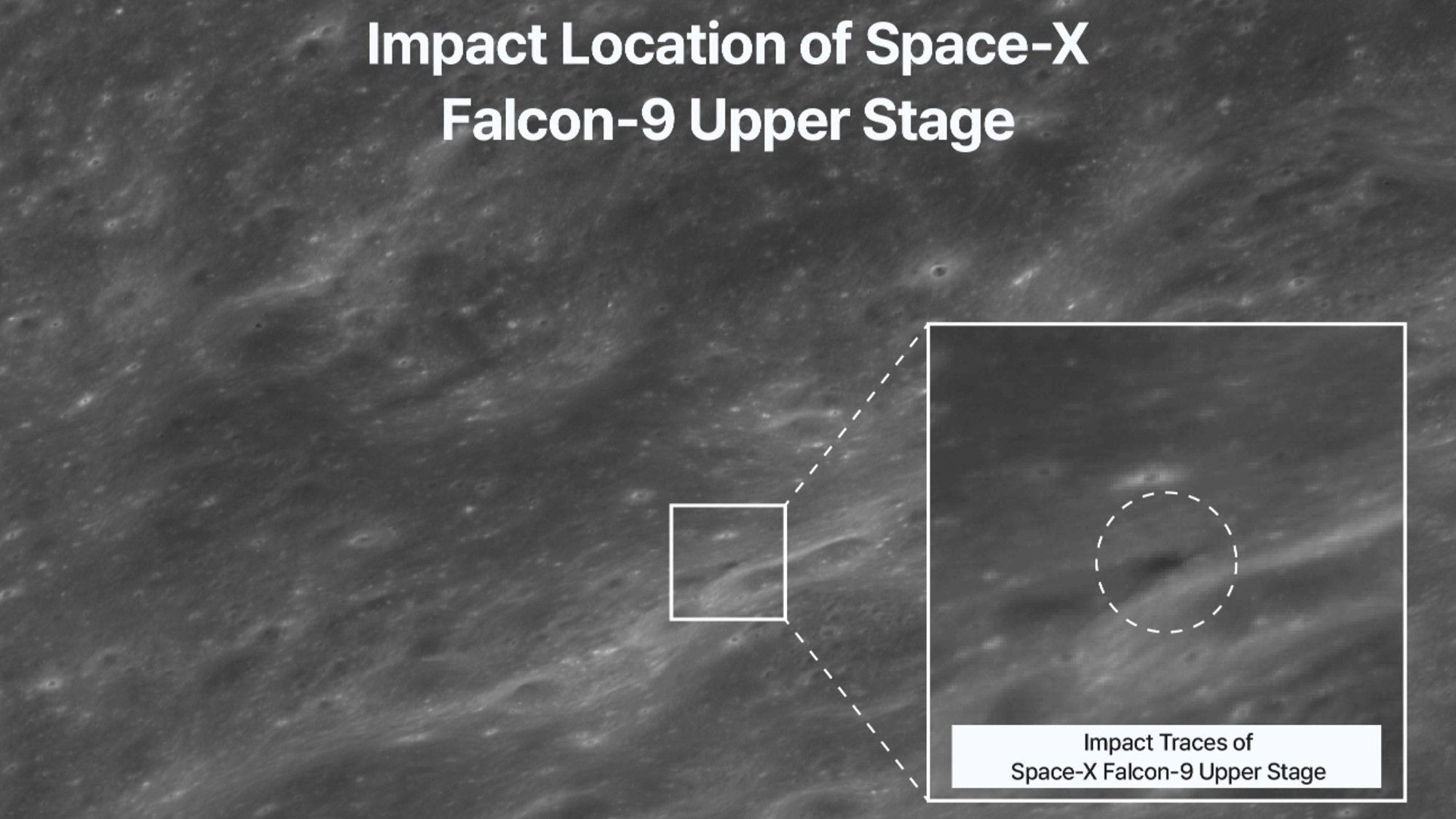
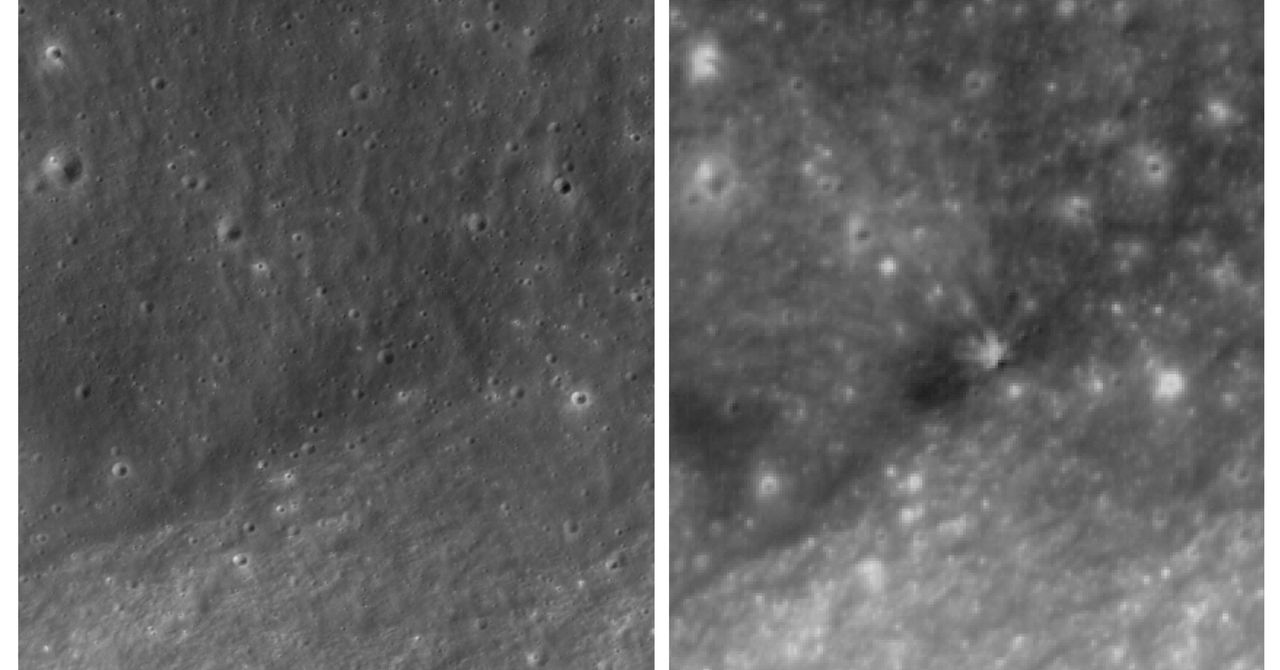
And for the first time, scientists have been able to photograph the area before and after the collision.
The First Images of the Impact
The first photographs came from an unexpected hero: South Korea's Danuri lunar orbiter.
Danuri, officially known as the Korea Pathfinder Lunar Orbiter, has been orbiting the Moon since 2022. Its cameras were positioned to observe the predicted impact zone, allowing scientists to collect images both before and after the collision.
The spacecraft conducted eight imaging sessions around the event.
One observation was made approximately 30 minutes before the predicted impact, followed by additional observations afterward. This is extremely valuable because scientists can compare the lunar surface before and after the event rather than simply finding a suspicious-looking crater later. ()
The result is subtle but significant.
The post-impact images show a darker area and changes in the surrounding terrain. Scientists also identified evidence consistent with material being thrown outward from the impact site.
In other words, the images provide visual confirmation that something happened exactly where astronomers predicted.
The crater itself is estimated to be several dozen feet across, with current estimates reaching roughly 27 meters in diameter. Other pre-impact modeling had suggested a crater around 40 meters across, demonstrating why actual observations are important.
The first images are not spectacular in the way a Hollywood movie might suggest.
There is no gigantic hole visible from Earth.
There is no glowing scar stretching across the lunar surface.
Instead, scientists are looking for small differences in grayscale images — subtle changes that reveal where several tons of artificial material struck the Moon at thousands of kilometers per hour.
And those differences could tell scientists quite a lot.
What Actually Hit the Moon?
The object was the upper stage of a Falcon 9 rocket.
That distinction is important.
Falcon 9 consists of multiple sections. The first stage performs the initial part of the launch and, on many missions, returns to Earth for recovery and reuse.
The upper stage is different.
After the payload has been delivered into its required trajectory, the upper stage may be discarded.
For ordinary Earth-orbit missions, operators can often perform a controlled disposal maneuver, directing the stage toward Earth's atmosphere where it burns up.
But missions going toward the Moon are different.
There is no atmosphere waiting to destroy an object traveling through cislunar space.
And once a rocket has used most of its propellant to send a payload toward the Moon, there may not be enough fuel remaining to perform another maneuver to safely dispose of the stage.
That is essentially what happened here.
SpaceX said the rocket stage had exhausted its fuel after deploying the lunar spacecraft and that solar activity and gravitational forces subsequently influenced its trajectory. The company also noted that controlled disposal is not always possible for higher-energy missions.
The rocket eventually became what could effectively be described as lunar space debris.
A Rocket Was Drifting Through Space for More Than a Year
Perhaps the strangest part of the story is that nobody simply "aimed" the rocket at the Moon.
Its eventual collision was not a planned lunar experiment.
After the January 2025 launch, the upper stage continued along a complicated trajectory.
Space is not empty in the simple sense we often imagine.
Every object is constantly influenced by gravity.
Earth pulls on it.
The Moon pulls on it.
The Sun pulls on it.
The exact trajectory of a large object can therefore evolve over time.
Small differences in velocity and position can eventually produce major changes in where an object ends up.
Scientists carefully tracked the Falcon 9 stage and refined their predictions as the impact approached.
By the summer of 2026, astronomers were able to calculate a remarkably precise prediction for the collision.
Researchers predicted that the rocket would strike the Moon near the region between the Bell and Einstein craters.
The impact location was on the Moon's far-side region as viewed in some descriptions, although the exact geometry depends on the observer's perspective and the lunar longitude involved. What mattered most for the observation campaign was that the site was sufficiently illuminated and accessible to lunar spacecraft. ()
Astronomers around the world prepared to watch.
Why Was It So Difficult to See the Crash?
You might reasonably ask:
If scientists knew exactly when it was going to happen, why didn't we simply watch it live?
The answer is surprisingly complicated.
The Moon is approximately 384,000 kilometers from Earth.
The impact occurred extremely quickly.
The rocket was traveling at around 2.4–2.5 kilometers per second when it hit.
That is thousands of kilometers per hour.
The impact itself lasted only an instant.
Furthermore, the collision occurred close to the lunar limb from some Earth-based viewing locations, making observation particularly difficult.
Even enormous telescopes have limitations.
Scientists had to know exactly where to look, exactly when to look and hope that atmospheric conditions and equipment were good enough.
Several observing campaigns attempted to detect the impact.
But the most valuable evidence eventually came from spacecraft already orbiting the Moon.
Danuri had the advantage of being in the right place.
The Impact Was More Powerful Than It Sounds
The Falcon 9 upper stage weighed approximately four tonnes.
That is roughly the mass of a large vehicle.
Now imagine accelerating several tonnes of metal to thousands of kilometers per hour and smashing it into an airless planetary surface.
The Moon has no substantial atmosphere to slow the object down.
There is no atmospheric heating phase like the one experienced by an object entering Earth's atmosphere.
The rocket simply arrived at enormous velocity and struck the ground.
Scientists had estimated an impact speed around 2.4 km/s.
The resulting energy was comparable to several tonnes of TNT, depending on the assumptions used for the mass and velocity of the object.
The collision excavated lunar material and sent debris outward.
This is called ejecta.
The ejecta contains material from beneath the original surface, meaning that the crater can effectively expose a fresh sample of the Moon's geological environment.
That is one of the reasons scientists are interested in this seemingly accidental event.
What Does the New Crater Look Like?
The first photographs are surprisingly understated.
Instead of a giant hole, the Danuri images show a relatively small area of altered terrain.
The most obvious feature is a darker patch around the impact location.
When scientists compare the pre-impact and post-impact photographs, the change becomes much easier to recognize.
The crater is tiny compared with the enormous impact structures that dominate the Moon.
But that does not make it unimportant.
For planetary scientists, a freshly created crater is a natural laboratory.
They know:
- what caused it,
- approximately how much the impactor weighed,
- its velocity,
- its trajectory,
- its composition,
- the approximate impact angle,
- and the exact time of the collision.
That combination is extremely valuable.
Most lunar craters do not come with a complete forensic record of their creation.
This one does.
NASA Will Take a Closer Look
Danuri is not the only spacecraft interested in the new crater.
NASA's Lunar Reconnaissance Orbiter (LRO) is also expected to examine the impact location.
LRO has been orbiting the Moon since 2009 and carries cameras capable of obtaining extremely detailed images of the lunar surface.
Scientists hope that LRO will provide higher-resolution observations of the new crater.
That could help answer several questions.
How wide is it?
How deep is it?
How much material was thrown outward?
What is the shape of the ejecta field?
Did the rocket penetrate deeply into the lunar regolith?
What materials were exposed?
And perhaps most interestingly:
How accurately did our models predict what would happen?
()
The Moon Has Been Hit by Human Objects Before
The SpaceX event is unusual, but it isn't the first time humans have deliberately or accidentally put hardware on the Moon.
In fact, the lunar surface contains quite a collection of human-made objects.
Apollo missions left equipment, scientific instruments and spent hardware.
Some spacecraft were intentionally crashed into the Moon to generate seismic signals that could be detected by instruments placed on the lunar surface.
NASA's LCROSS mission deliberately impacted the Moon in 2009.
The spacecraft's upper stage hit a permanently shadowed crater near the lunar south pole, while another spacecraft observed the resulting plume.
That experiment helped scientists investigate the presence of water and other materials.
So the idea of a spacecraft crashing into the Moon isn't new.
What makes the 2026 Falcon 9 collision interesting is that it was unplanned.
Is This "Polluting" the Moon?
This is where the story becomes much more complicated.
The images immediately generated debate online.
Some people described the event as humanity beginning to "pollute" the Moon.
Others argued that calling it pollution dramatically exaggerates the environmental significance.
Both perspectives contain part of the truth.
From a purely geological perspective, the Moon is not being dramatically damaged.
A crater only a few dozen meters wide is microscopic compared with the lunar surface.
The Moon has been bombarded by natural objects for billions of years.
Meteorites and asteroids have created countless impact craters.
One new human-made crater does not fundamentally change the Moon.
NASA Administrator Jared Isaacman has pointed out that impacts of roughly this scale occur naturally on the Moon with considerable frequency.
But the philosophical question is different.
Humanity is entering a period in which lunar activity is expected to increase dramatically.
More spacecraft.
More landers.
More rovers.
More satellites.
Eventually, potentially:
human settlements.
And with more activity comes more hardware.
The Real Problem Is Not This One Crater
The biggest lesson from the Falcon 9 impact is not that one rocket damaged the Moon.
It is that cislunar space is becoming busier.
For decades, most space traffic occurred relatively close to Earth.
Now the situation is changing.
Countries and private companies are sending spacecraft toward the Moon.
The United States is developing Artemis missions.
China is pursuing an ambitious lunar exploration program.
India, Japan, South Korea and European institutions are expanding lunar science.
Private companies are developing commercial lunar landers.
Space agencies are discussing lunar bases and long-term infrastructure.
The Moon is slowly becoming an active destination rather than a distant scientific object.
That means traffic management will become increasingly important.
What Happens When Lunar Traffic Becomes Normal?
Imagine the Moon in 2040.
There could be:
- communications satellites,
- navigation systems,
- scientific spacecraft,
- cargo landers,
- mining equipment,
- rovers,
- power systems,
- habitats,
- launch vehicles,
- and potentially crewed spacecraft.
What happens to all of the hardware that stops working?
Where does it go?
Who is responsible for it?
Can it simply be abandoned?
Should every mission include a disposal plan?
Should spacecraft be intentionally moved into stable orbits?
Should certain lunar regions be protected?
And who decides?
These questions sound futuristic.
After August 5, 2026, they are considerably less theoretical.
Space Debris Is No Longer Just an Earth Problem
For years, "space junk" mostly meant objects orbiting Earth.
Dead satellites.
Rocket stages.
Fragments from collisions.
Tiny pieces of debris traveling at extraordinary speeds.
The Moon introduces a new dimension.
Objects traveling between Earth and the Moon occupy what is often called cislunar space.
This region will become increasingly important as lunar exploration expands.
And tracking objects there is significantly more difficult than tracking objects in low Earth orbit.
The Falcon 9 stage became an excellent demonstration of this problem.
Researchers had to continuously refine its trajectory because its orbit was affected by gravitational interactions and solar forces.
The object was not simply parked somewhere waiting for someone to recover it.
It was moving through a dynamic gravitational environment.
Why This Accident Could Actually Help Science
There is an ironic side to the story.
A rocket that was never intended to become a scientific instrument has now become one.
Scientists can use the impact to study:
Impact physics
The collision provides real-world data about how a large artificial object behaves when it strikes the lunar surface.
Lunar soil
The impact excavated fresh material.
Ejecta
Scientists can analyze how far material traveled and how it was distributed.
Crater formation
The new crater provides a controlled case for testing impact models.
Space debris
The event demonstrates the importance of tracking objects traveling beyond Earth orbit.
Future mission planning
Engineers can use the observations when designing disposal strategies for future lunar missions.
The accident therefore becomes a scientific experiment that nobody originally planned.
A New Era of Lunar Exploration
Perhaps the most fascinating part of this story is what it represents.
The Moon is no longer simply a destination for governments.
Private companies are going there.
Commercial spacecraft are going there.
Reusable rockets are sending increasingly sophisticated payloads toward it.
And the boundaries between space exploration and commercial activity are becoming increasingly blurred.
The Falcon 9 upper stage was part of a mission carrying private lunar landers.
One of those landers, Firefly Aerospace's Blue Ghost, successfully reached the Moon.
Another spacecraft, ispace's Resilience, did not complete its landing successfully.
The rocket stage had its own unexpected ending.
It became a lunar impactor.
That sequence — commercial launch, lunar payloads, private spacecraft and accidental lunar impact — is almost a perfect snapshot of the new space age.
The Moon Is Becoming a Place Humans Leave Things
There is something psychologically strange about looking at the Moon and knowing that humans have already left objects there.
Apollo astronauts left equipment.
Robotic missions left landers.
Rovers remain on the surface.
Scientific experiments continue to sit where astronauts and spacecraft placed them decades ago.
And now there is a fresh crater created by a piece of a modern commercial rocket.
The Moon is slowly becoming an archaeological record of human exploration.
Future astronauts may one day look back at these early missions in the same way archaeologists study ancient civilizations on Earth.
They may find the remnants of our first technological steps beyond our planet.
Will Humans Eventually Build on the Moon?
This is perhaps the most important question raised by the accident.
If humanity establishes permanent infrastructure on the Moon, uncontrolled impacts become a more serious issue.
A four-tonne rocket stage crashing into an empty region is one thing.
A similar object striking near a habitat, power station, communication array or scientific installation would be very different.
Future lunar missions will therefore need increasingly sophisticated traffic management.
Operators will have to consider not only whether a spacecraft can reach the Moon, but also what happens after its mission ends.
The age of simply abandoning hardware may eventually come to an end.
The Moon's New Scar Is Tiny — But Symbolic
Technically, the new crater is insignificant.
The Moon is approximately 4.5 billion years old.
Its surface has been repeatedly bombarded by asteroids and comets.
A crater a few dozen meters wide is nothing on a planetary scale.
But humans are not used to thinking about the Moon as a place where our technological footprint matters.
For most of human history, the Moon was something we looked at.
Then, for a brief moment in the 20th century, humans walked on it.
Now we are beginning to use it.
That is a profound transition.
The Falcon 9 impact therefore matters less because of the physical size of the crater and more because of what it tells us about the future.
The Moon Has Given Us a Warning
The new crater does not mean that SpaceX has "destroyed" the Moon.
It has not.
There is no meaningful ecological catastrophe.
The lunar surface has survived impacts vastly more powerful than this one.
But the event provides an early warning about something much bigger.
Human activity beyond Earth is becoming normal.
And when something becomes normal, infrastructure follows.
Traffic follows.
Rules follow.
Conflicts over responsibility follow.
Eventually, so does regulation.
The Falcon 9 stage was not supposed to become a lunar landmark.
Yet it did.
It left behind a tiny, artificial scar that can now be photographed from orbit.
And that scar may eventually become a historical footnote marking the moment when humanity began to confront a new problem:
What do we do with our space junk when space becomes a place we actually live and work?
The First Human-Made Crater of the New Lunar Era?
The Moon has been struck by human spacecraft many times.
So technically, this is not the first human-made crater on the Moon.
But the circumstances are different.
This was not an Apollo experiment.
It was not a deliberate scientific impact.
It was not a spacecraft intentionally sent toward the lunar surface.
It was an unplanned consequence of increasingly complex commercial activity around the Moon.
That distinction could become more important in the coming decades.
Because the number of missions heading toward the Moon is expected to grow.
And the more objects humanity sends into cislunar space, the more important it becomes to know where those objects will eventually end up.
What We Know — and What We Still Don't
The first images answer some questions.
They confirm that the Falcon 9 stage reached the predicted impact region.
They show changes in the lunar terrain.
They reveal evidence of ejecta.
They demonstrate that a new impact feature has been created.
But many details remain to be determined.
Scientists still need better measurements of the crater's:
diameter, depth, morphology and ejecta distribution.
NASA's Lunar Reconnaissance Orbiter should provide additional information.
Further analysis could also reveal how much of the rocket itself remained at the impact site and how much material was dispersed.
The more data scientists collect, the better they will understand what happened.
And that information could influence the design of future lunar missions.
A Photograph That Tells a Much Bigger Story
The new image is not spectacular.
That is precisely what makes it fascinating.
A casual observer might look at the photograph and see little more than a blurry patch of gray lunar terrain.
A planetary scientist sees something completely different.
They see:
a known object,
a known trajectory,
a known impact velocity,
a known impact time,
a measurable crater,
and a fresh experiment on another world.
The Moon has recorded the event permanently.
Unlike Earth, where erosion, weather and geological activity constantly alter the landscape, lunar scars can survive for extremely long periods.
The crater created on August 5, 2026, may remain there for millions of years.
Long after the Falcon 9 rocket is forgotten.
Long after today's space companies have changed.
Long after the current generation of lunar missions has ended.
The Moon will still have the mark.
The Beginning of Something Bigger
A discarded rocket stage crashing into the Moon may sound like an unusual one-day news story.
But it is really part of a much larger transformation.
Humanity is moving from simply visiting space to increasingly operating in space.
That means we need to think about sustainability beyond Earth.
We need to think about traffic.
We need to think about abandoned hardware.
We need to think about protected scientific locations.
We need to think about lunar resources.
And eventually, we will need to think about something that until recently sounded almost absurd:
lunar environmental policy.
The Moon has no forests to protect and no oceans to pollute.
But it has scientific sites, historic landing locations, valuable geological areas and potentially important resources.
The question is no longer whether humans will change the Moon.
We already have.
The question is how much more we are going to change it.
A Tiny Crater With a Huge Message
On August 5, 2026, a four-tonne piece of a Falcon 9 rocket reached the end of its unexpected journey.
It crossed space for more than a year.
Gravity slowly changed its trajectory.
Astronomers tracked it.
Scientists predicted its collision.
And a South Korean spacecraft watched the aftermath.
The result was a small new crater on the lunar surface.
It is not dangerous.
It is not catastrophic.
It is not going to change the Moon.
But it is a remarkable symbol of where humanity is heading.
For thousands of years, the Moon was the ultimate distant object — something beyond human reach.
Today, spacecraft routinely travel there.
Tomorrow, humans may build there.
And one day, people may look at the lunar surface not only as a landscape shaped by asteroids and ancient geology, but also as a landscape carrying the unmistakable fingerprints of civilization.
The first images of this new crater are therefore more than photographs of a hole in the ground.
They are photographs of humanity entering another phase of space exploration.
And the next crater we create may not be an accident.
Sources & further reading
The first post-impact observations were made by South Korea's Danuri lunar orbiter, with additional observations expected from NASA's Lunar Reconnaissance Orbiter.
The scientific prediction of the impact trajectory and expected crater was published before the collision and estimated an impact speed of roughly 2.4 km/s.