

The Mediterranean Sea is one of the most intensively studied marine environments in the world. Every year, millions of tourists visit its coastlines, scientists monitor its ecosystems, and researchers investigate the extraordinary variety of organisms living beneath its surface. Yet, despite decades of scientific research, the sea continues to reveal surprises.
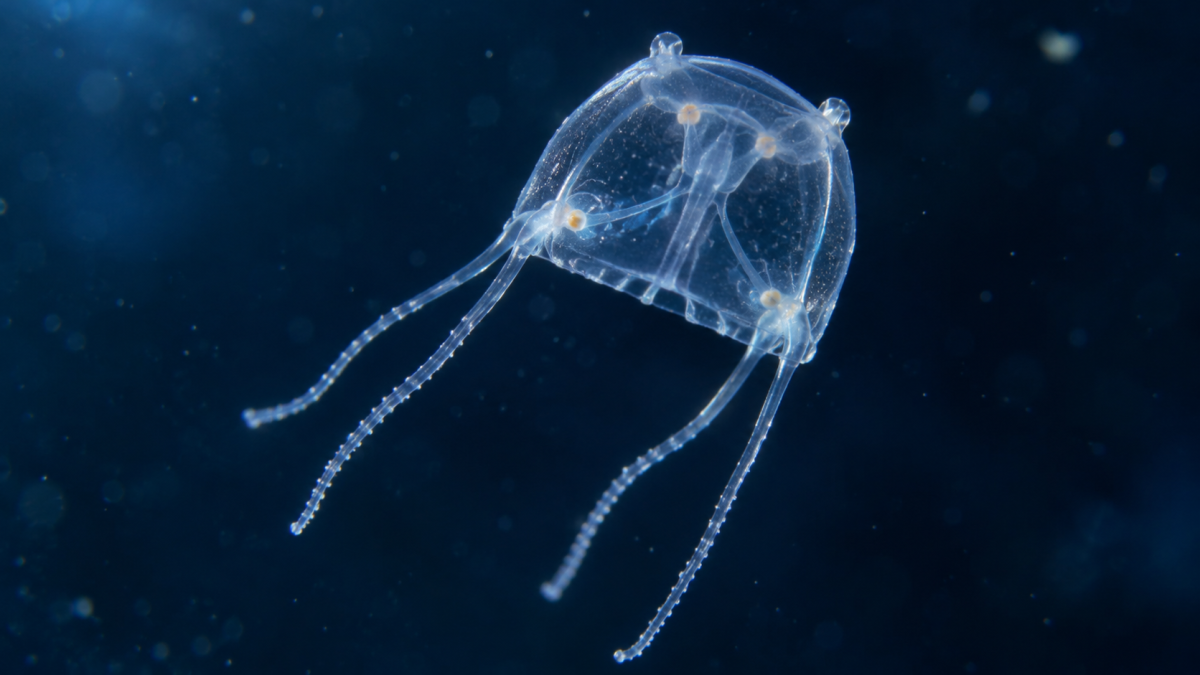
One of the latest discoveries is particularly fascinating because of its size. Scientists from the University of Alicante in Spain have brought attention to a previously identified but still poorly understood jellyfish species known as Copula lucentia. This extraordinarily small marine animal measures only a few millimetres and is almost completely transparent, making it extremely difficult to notice without specialised equipment.
The discovery is especially significant because Copula lucentia represents only the second documented box jellyfish species recorded in the Mediterranean Sea. Its presence demonstrates that even familiar European waters may contain organisms that have escaped scientific attention for decades.
Researchers have recently returned to the waters where the species was originally collected. In cooperation with the Oceanogràfic aquarium in Valencia, a new research campaign successfully gathered more than 200 specimens. Scientists are now studying the animals in controlled conditions, hoping to understand their development, reproductive biology and ecological importance.
The story of Copula lucentia is not simply about finding another jellyfish. It raises much broader questions about how much scientists still do not know about marine biodiversity, why tiny organisms matter to ocean ecosystems and what discoveries may be waiting in the waters people swim in every summer.
A New Species Hidden in the Waters of Spain
The story of Copula lucentia begins near El Campello, a coastal municipality in the province of Alicante, on Spain's southeastern Mediterranean coast.
The area is known for its beaches, rocky coastline and clear waters. It is a popular destination for residents and international visitors, particularly during the warmer months. However, beneath the familiar coastal landscape lies a marine environment that continues to attract scientific interest.
The jellyfish was originally collected during research campaigns conducted between 2016 and 2018. Scientists from the University of Alicante's Marine Laboratory in Dénia were examining small marine organisms when they encountered specimens that did not quite match the characteristics of species already known to science.
At first, the researchers were surprised by the animals' unusually small size and certain anatomical features. Their appearance suggested that they belonged to a group of box jellyfish, but several details did not correspond with the descriptions available in scientific literature.
Rather than classifying them as a variation of an existing species, the researchers decided to investigate further.
The team conducted detailed morphological examinations and genetic analyses, comparing the specimens with related jellyfish from other parts of the world. These investigations eventually confirmed that the animals represented a distinct species within the genus Copula.
The scientific description was published on August 20, 2024, in the journal Marine Biodiversity, under the title:
Copula lucentia sp. nov., a new box jellyfish (Cnidaria: Cubozoa: Carybdeida) from Western Mediterranean Sea.
The study was authored by an international group of researchers, including Eva S. Fonfría and César Bordehore from the University of Alicante.
The university highlighted the discovery again in November 2026, drawing attention to the new research campaign and the successful collection of more than 200 additional specimens.
This distinction between the original scientific description and the more recent research campaign is important. The species was not discovered for the first time in November 2026. Instead, the latest announcement brought renewed attention to a discovery that scientists are now investigating in greater detail.
What Is Copula lucentia?
Copula lucentia belongs to the class Cubozoa, commonly known as box jellyfish or cubomedusae.
Unlike many familiar jellyfish, which have rounded or dome-shaped bells, box jellyfish typically possess a more angular, cube-like body structure. Their distinctive anatomy makes them particularly interesting to marine biologists.
The newly described Mediterranean species is remarkably small. Its recorded dimensions range from approximately one to seven millimetres, depending on the individual and the measurement used.
Some examined specimens were only slightly larger than a grain of rice.
Its body is almost completely transparent and colourless. This characteristic makes it difficult to distinguish from the surrounding water, especially when viewed without magnification.
The bell has a blunt, slightly flattened pyramidal shape. It is wider than it is high and contains several anatomical structures that help scientists distinguish the species from related organisms.
The jellyfish also has four tentacles and four small adhesive structures positioned near the upper part of its bell.
These structures are particularly interesting because they are associated with the ability to attach to different surfaces.
Although the animal may appear simple at first glance, its anatomy contains several features that are important for accurate scientific identification.
In fact, identifying Copula lucentia required researchers to examine structures that are practically impossible to recognise with the naked eye.
Its tiny size is one reason why this species remained poorly understood before the research team began examining it.
Why Is It Called Copula lucentia?
Scientific names often contain clues about the history, geography or characteristics of the organisms they describe.
In this case, the name Copula lucentia has a direct connection to the Spanish province where the species was found.
The second part of the name refers to Lucentum, the ancient Latin name associated with Alicante.
The researchers selected this name to recognise the geographical origin of the discovery.
The first part, Copula, identifies the genus to which the animal belongs.
Scientific classification is important because it allows researchers around the world to communicate precisely about different organisms. Common names can vary between languages and countries, but a scientific name provides a standard reference.
For a newly described species, this is particularly important. It establishes its position within the wider biological classification system and allows future studies to build upon the original research.
The discovery also adds a new geographical dimension to the known distribution of the genus Copula, which had previously been associated with marine environments in other parts of the world.
The Second Documented Box Jellyfish Species in the Mediterranean
One of the most important aspects of this discovery is its taxonomic significance.
According to the University of Alicante, Copula lucentia is the second documented box jellyfish species recorded in the Mediterranean Sea.
The other species is Carybdea marsupialis, which was described by Carl Linnaeus in 1758.
For more than two centuries, scientists have been documenting the biology and distribution of marine organisms in the Mediterranean. The identification of another box jellyfish species highlights how incomplete our understanding of marine biodiversity can still be.
Box jellyfish are a relatively small group within the wider world of jellyfish diversity. Their distinctive body structure, sensory systems and movement patterns make them particularly interesting subjects for scientific investigation.
The discovery of Copula lucentia also raises questions about other small organisms that may be present in the Mediterranean but have not yet been properly identified.
Many marine animals are difficult to study because they are extremely small, transparent or present only during particular seasons.
Some species may also resemble one another so closely that they cannot be reliably distinguished through visual observation alone.
This is where modern genetic techniques become particularly important.
A marine organism that appears to be an ordinary example of a known species may actually represent a completely different evolutionary lineage.
For scientists, this means that the discovery of Copula lucentia could be part of a much larger story about the hidden diversity of the Mediterranean.
How Scientists Identified a Species Measuring Only a Few Millimetres
Identifying a new species is rarely a matter of simply observing an unusual animal.
Researchers must demonstrate that the organism possesses characteristics that distinguish it from other known species.
In the case of Copula lucentia, the scientific team combined two important approaches: morphological examination and molecular analysis.
Morphological research focuses on the physical structure of an organism. Scientists examine the shape, proportions and arrangement of different anatomical features.
For a tiny jellyfish, this can require advanced microscopy and highly detailed observations.
The researchers paid particular attention to the bell structure, adhesive pads, tentacles and internal anatomical features.
One of the most important differences involved the arrangement of small canals inside the bell.
These structures are known as velarial canals and are associated with the jellyfish's swimming apparatus.
In Copula lucentia, the canals have narrow, triangular shapes with pointed tips. This pattern differs from the broader, more finger-like structures described in the related species Copula sivickisi.
Such differences may appear extremely subtle, but in taxonomy they can provide essential evidence that two organisms represent separate species.
The second part of the investigation involved genetic analysis.
The researchers examined mitochondrial cytochrome c oxidase subunit I, commonly abbreviated as COI, as well as nuclear 16S ribosomal DNA.
These genetic markers help scientists compare organisms at the molecular level.
By examining genetic differences alongside physical characteristics, researchers were able to confirm that the Mediterranean specimens were not simply unusual individuals of an already known species.
The combination of these methods provided the evidence needed to establish Copula lucentia as a new species.
This approach illustrates how modern taxonomy increasingly combines traditional anatomical observation with molecular biology.
It also demonstrates why some organisms remain scientifically overlooked for long periods. Without detailed examination, a species measuring only a few millimetres may easily be mistaken for something already known.
Where Does the Tiny Jellyfish Live?
So far, the documented distribution of Copula lucentia is extremely limited.
The species has been recorded at El Campello, on the coast of Alicante in southeastern Spain.
The original research focused on a rocky coastal area near Illeta dels Banyets, a small peninsula surrounded by a mixture of marine habitats.
The environment includes rocky surfaces, sandy seabeds and patches of seagrass meadows.
These different habitats create a complex coastal ecosystem in which numerous small marine organisms can live.
The jellyfish was collected in shallow water, at depths of less than 1.5 metres.
This is particularly interesting because the species was found in an environment that is relatively accessible to people.
Many tourists visiting Mediterranean beaches spend time in water of similar depth.
However, this does not mean that the jellyfish is commonly encountered by swimmers. Its tiny dimensions and transparent body make it extremely difficult to see.
The original scientific study also found that the species was collected mainly during September and October, with some additional observations in November.
Researchers recorded hundreds of specimens during sampling campaigns between 2016 and 2018.
These observations suggest that the species may have a seasonal pattern of occurrence, although further research is needed before its full life cycle can be understood.
It is also important to remember that scientists have not yet established the complete geographical distribution of Copula lucentia.
The fact that it has been documented at El Campello does not necessarily mean that it exists nowhere else.
It may occur in other Mediterranean locations but remain undetected because of its size, seasonal behaviour or specific habitat requirements.
Future research will be essential to determine whether this jellyfish is restricted to a small area of the Spanish coast or has a wider distribution.
More Than 200 Specimens Collected After Eight Years
One of the most significant developments announced by the University of Alicante in November 2026 concerns a new research campaign.
Eight years after the last collection campaigns, researchers returned to the area in cooperation with the Oceanogràfic aquarium in Valencia.
The results were encouraging.
The team successfully located and collected more than 200 specimens of Copula lucentia.
This new collection provides scientists with an important opportunity to investigate a species that remains poorly understood.
The availability of additional specimens is particularly valuable because the original research was based on a relatively limited number of individuals suitable for detailed taxonomic examination.
A larger collection allows researchers to observe variation between individuals and investigate different stages of development.
It also creates opportunities to study the animal under controlled conditions.
Some of the collected jellyfish have been transferred to the Medusa Lab at the Oceanogràfic.
There, specialists are attempting to maintain the animals and support their development.
One of the main objectives is to determine whether the species can reach sexual maturity and reproduce in aquarium conditions.
This would be an important achievement because scientists still know very little about its reproductive biology.
The research is also an example of how cooperation between universities and specialist marine institutions can produce results that would be difficult for either organisation to achieve independently.
The University of Alicante contributes expertise in marine ecology, taxonomy and genetics, while the Oceanogràfic provides specialist knowledge and facilities for maintaining jellyfish.
Together, the teams hope to answer questions that have remained unresolved since the species was first identified.
Scientists Still Know Very Little About Its Life Cycle
Despite the successful identification of Copula lucentia, many aspects of its biology remain unknown.
One of the biggest challenges is understanding its complete life cycle.
Like other jellyfish, box jellyfish have a complex developmental biology that can involve different stages.
However, the specific reproductive and developmental processes of Copula lucentia have not yet been fully established.
The specimens examined in the original scientific study were immature females.
The recently collected animals are also still in an immature developmental stage, according to the University of Alicante's November 2026 announcement.
This means that researchers have not yet been able to observe the complete reproductive cycle under controlled conditions.
The Medusa Lab project aims to change that.
If scientists can successfully maintain the animals until they reach maturity, they may be able to observe reproductive behaviour and potentially establish a captive population.
Such work could reveal how the species develops, how quickly it grows and what environmental conditions are necessary for its survival.
Researchers may also discover whether its reproductive cycle follows a predictable seasonal pattern.
Understanding these processes is essential for studying the species in its natural environment.
Without information about reproduction and development, it is difficult to estimate population size, identify potential threats or understand how the jellyfish responds to environmental changes.
The research therefore represents an important first step rather than the conclusion of the scientific investigation.
Is Copula lucentia Dangerous to Humans?
The discovery of a new jellyfish naturally raises an important question for people who swim in the Mediterranean: could this tiny animal be dangerous?
The available scientific evidence suggests that Copula lucentia has not been associated with documented stinging incidents in the area where it was found.
During the original research, scientists did not observe stinging activity while collecting and handling specimens.
The University of Alicante has also described the species as harmless to humans in its public announcement.
However, there is an important scientific qualification.
The researchers have not completed dedicated toxicological studies that would allow them to determine its stinging potential with complete certainty.
For this reason, the original scientific publication does not completely rule out the possibility of envenomation.
This distinction matters because box jellyfish are a diverse group.
Some species are associated with painful stings, while others have a much less significant impact on humans.
It would therefore be incorrect to assume that every box jellyfish is equally dangerous.
The size of Copula lucentia is another interesting characteristic. At just a few millimetres, it is much smaller than many jellyfish that swimmers encounter in coastal waters.
Nevertheless, small size alone cannot establish whether an animal is harmless.
Researchers still need to investigate its stinging cells, venom composition and potential effects.
Until those studies are completed, the most accurate conclusion is that no stinging incidents have been attributed to Copula lucentia so far, but its toxicological characteristics require further research.
For beach visitors, this discovery should not be a reason to avoid the Spanish Mediterranean coast.
It is primarily a scientific finding that highlights the importance of understanding marine organisms before making assumptions about their behaviour or potential effects on humans.
Why Such a Tiny Organism Matters to the Marine Ecosystem
It may be tempting to assume that an animal measuring only a few millimetres has little influence on its surrounding environment.
Marine ecosystems, however, depend on interactions between organisms of many different sizes.
Tiny planktonic and gelatinous organisms can play important roles in marine food webs.
They may serve as predators, consumers or prey for other species.
The University of Alicante has highlighted the importance of understanding small gelatinous organisms because some of them feed on fish eggs and larvae.
This is particularly relevant to fisheries and the wider management of marine resources.
Fish populations depend on successful reproduction and the survival of young individuals.
If large numbers of eggs and larvae are consumed by small marine predators, this can influence recruitment and ultimately affect fish populations.
The exact ecological role of Copula lucentia has not yet been established.
Scientists still need to investigate its diet, feeding behaviour and interactions with other organisms.
However, the species provides another reason to pay attention to the less visible components of marine ecosystems.
Understanding larger animals such as dolphins, turtles and whales is important, but the organisms at the smallest levels of the food web also deserve attention.
A complete picture of marine biodiversity requires studying all these interconnected groups.
This is one reason why the new research campaign is significant beyond the discovery of a single species.
It could contribute to a better understanding of how gelatinous organisms interact with other marine life in the Mediterranean.
The Mediterranean Sea Is Still Full of Scientific Mysteries
The Mediterranean is often described as one of the world's most studied seas.
It connects three continents and contains an extraordinary variety of coastal and offshore habitats.
Its waters support numerous fish species, marine mammals, turtles, molluscs, crustaceans, planktonic organisms and other forms of life.
However, scientific knowledge is not distributed equally across all these groups.
Large and commercially important species are generally easier to observe and monitor.
Small organisms, particularly transparent animals living in shallow water, can be much more difficult to study.
This creates an interesting paradox.
A sea that appears familiar to millions of people may still contain species that scientists have only recently begun to understand.
The discovery of Copula lucentia illustrates this perfectly.
The animal was found close to a popular Spanish coastal destination, not in an isolated part of the ocean that is difficult to reach.
Its existence was established through research that required detailed sampling, anatomical examination and genetic analysis.
This suggests that the boundaries of scientific knowledge are not necessarily determined by how remote an environment is.
Sometimes the most interesting discoveries are hiding in places that people have visited for generations.
The Mediterranean also contains many different microhabitats, including seagrass meadows, rocky reefs, sandy seabeds and sheltered coastal areas.
Each habitat supports organisms adapted to particular environmental conditions.
Studying these environments in detail may reveal additional species and improve our understanding of how Mediterranean biodiversity is organised.
For marine scientists, the discovery is therefore both an achievement and a reminder that much work remains to be done.
Why Seagrass Meadows and Rocky Habitats Deserve Attention
The environment where Copula lucentia was collected is particularly interesting because it includes several different habitat types.
The original study describes rocky areas, sandy bottoms and patches of Posidonia oceanica seagrass meadows.
These habitats are important components of Mediterranean coastal ecosystems.
Posidonia oceanica is a marine flowering plant endemic to the Mediterranean.
Unlike seaweed, it produces flowers, fruits and seeds and forms extensive underwater meadows.
These meadows provide shelter and feeding grounds for numerous marine organisms.
They also contribute to the stability of coastal environments by helping reduce sediment movement and supporting biodiversity.
Rocky habitats offer a different range of ecological opportunities.
They provide surfaces for organisms to attach to and create small spaces where invertebrates can shelter.
Sandy seabeds, meanwhile, support burrowing animals and organisms adapted to life within or on top of sediment.
The combination of these environments creates a complex ecosystem within a relatively small geographical area.
For a tiny jellyfish, such habitats may provide suitable conditions for different stages of its development.
However, researchers have not yet established precisely which environmental factors are essential for Copula lucentia.
Further studies will need to investigate its habitat preferences and whether it depends on particular coastal conditions.
Protecting Mediterranean habitats is therefore important not only for well-known species but also for organisms that remain poorly understood.
Could Climate Change Affect This Newly Identified Jellyfish?
Climate change is one of the major challenges facing marine ecosystems around the world.
Increasing sea temperatures, changes in circulation patterns, marine heatwaves and shifts in seasonal conditions can influence the distribution and behaviour of many marine organisms.
Jellyfish are often discussed in connection with changing ocean conditions.
Some species can respond rapidly to environmental changes, although their reactions differ considerably depending on their biology and habitat requirements.
For Copula lucentia, however, there is not yet enough evidence to establish how climate change may affect its population.
The original study recorded most specimens in relatively warm water, generally between approximately 22.3 and 28 degrees Celsius.
These observations provide useful information about the conditions in which the animals were collected.
They do not prove that the species requires a particular temperature range or that rising temperatures will necessarily increase its population.
Scientists would need longer-term monitoring and controlled experiments to investigate these questions.
For example, researchers could examine how different temperatures influence growth, development and survival.
They could also investigate whether changes in seasonal conditions affect the timing of reproduction.
Another important question concerns geographical distribution.
If environmental conditions change, the species may potentially be found in locations where it has not previously been recorded.
However, such a possibility should not be confused with evidence that Copula lucentia is already expanding its range.
At present, its documented distribution remains limited to the original locality near El Campello.
Future monitoring could help determine whether its presence is stable, seasonal or influenced by environmental changes.
The Importance of Modern Genetic Research
The identification of Copula lucentia also demonstrates how genetic research is transforming marine biology.
For centuries, scientists classified organisms primarily through their physical characteristics.
This traditional approach remains essential, but it can be challenging when organisms are extremely small or look almost identical.
Modern genetic techniques provide another way to investigate biological diversity.
By comparing selected DNA sequences, researchers can identify genetic differences between populations and species.
In the case of Copula lucentia, analyses of COI and 16S genetic markers helped confirm that the Mediterranean specimens represented a distinct species.
This is particularly relevant for organisms that may contain several closely related or previously unrecognised species.
The genus Copula itself provides an interesting example.
Before the Mediterranean discovery, Copula sivickisi was the recognised species within the genus.
The research team identified morphological and genetic differences that justified describing Copula lucentia separately.
The authors also suggested that additional research into the genus may reveal further diversity.
This means that the Mediterranean discovery could be part of a broader revision of how scientists understand the evolutionary relationships between these jellyfish.
Genetic research does not replace traditional taxonomy.
Instead, it complements anatomical observations and allows researchers to build a more complete picture of evolutionary history.
For tiny marine organisms, this combination can be particularly valuable.
The Oceanogràfic and the Challenge of Studying Tiny Jellyfish
The involvement of the Oceanogràfic in Valencia is another important part of the story.
The institution is known for its marine exhibitions, research activities and work involving aquatic organisms.
Its specialist Medusa Lab provides facilities for maintaining and studying jellyfish.
Keeping a species such as Copula lucentia in controlled conditions is a considerable scientific challenge.
Its extremely small size means that researchers must pay close attention to the surrounding environment and the conditions required for its survival.
Water quality, feeding, temperature and the availability of suitable conditions can all influence whether specimens survive and develop successfully.
The fact that this is the first time the species has been maintained in an aquarium makes the project especially interesting.
Researchers are not simply observing an animal that is already well understood.
They are learning how to maintain a newly described species while simultaneously investigating its biology.
The next major objective is to help the specimens reach sexual maturity.
If successful, this could provide scientists with their first opportunity to study the reproductive cycle of Copula lucentia under controlled conditions.
Such knowledge could be useful for future research into other small box jellyfish.
It may also help researchers understand how environmental factors influence the development of different jellyfish species.
The cooperation between the University of Alicante and the Oceanogràfic demonstrates the value of combining field research with specialist aquarium facilities.
Sea4Future: A Wider Project to Understand and Protect the Mediterranean
The research into Copula lucentia is also connected to broader efforts to improve knowledge of Mediterranean marine ecosystems.
The University of Alicante team participates in the Sea4Future project, an initiative involving 23 partners from 12 countries.
The project is supported through the European Union's Horizon Europe research framework.
Its wider objective is to develop approaches that can help restore fisheries production while protecting vulnerable marine species and ecosystems.
The work involves different areas of marine science and requires cooperation between researchers and institutions.
Understanding gelatinous organisms is one part of this wider challenge.
Small marine organisms may influence food webs and interact with fish populations in ways that are not always immediately obvious.
At the same time, Mediterranean ecosystems support vulnerable species such as sea turtles, dolphins and whales.
Protecting these animals requires understanding the wider environment in which they live.
Research into small jellyfish may therefore contribute to a broader understanding of marine ecological relationships.
It is important to stress that Copula lucentia is not itself the main objective of Sea4Future.
Rather, its study fits into a wider scientific effort to understand the complexity of Mediterranean marine ecosystems.
This is a useful reminder that discoveries involving individual species can have relevance beyond the organisms themselves.
Could There Be More Undiscovered Species in the Mediterranean?
The discovery of Copula lucentia naturally leads to another question: how many other species remain unidentified in the Mediterranean?
There is no simple number that can answer this question.
Marine biodiversity is extremely complex, and the number of organisms known to science changes as new species are discovered and existing classifications are revised.
Some marine organisms are relatively easy to observe.
Others spend most of their lives in habitats that are difficult to access or are so small that they require specialised sampling techniques.
Transparent planktonic organisms are particularly challenging.
Their appearance can make them almost invisible in the water, while their small size makes them difficult to distinguish from other species.
Some may also have seasonal life cycles, appearing in significant numbers only during particular periods.
This means that researchers could visit the same location several times without encountering the species they are looking for.
The original study of Copula lucentia provides a practical example.
The researchers conducted repeated sampling campaigns between August and November over three consecutive years.
The species was mainly collected in September and October.
Such results demonstrate why long-term monitoring can be important.
A single research expedition may provide only a limited picture of the organisms living in a particular marine environment.
Repeated investigations can reveal patterns that would otherwise remain hidden.
The Mediterranean may therefore contain additional small species that have not yet been formally described.
However, each potential discovery requires careful scientific verification.
An unusual-looking animal is not automatically a new species.
Researchers must compare it with existing descriptions and, where appropriate, conduct genetic analyses.
The process can take considerable time, but it is essential for maintaining the accuracy of scientific knowledge.
Why Small Marine Discoveries Matter Beyond Science
The story of Copula lucentia also has a broader message for people who do not work in marine biology.
It shows that the natural world is far more complex than it may appear.
For many visitors, the Mediterranean is primarily associated with beaches, holidays, swimming and coastal tourism.
Yet beneath the surface lies a network of biological relationships that remains only partially understood.
Small organisms can influence larger ecosystems, and discoveries involving them may contribute to more effective environmental protection.
This is particularly relevant as coastal areas experience growing pressure from tourism, development, pollution and climate-related changes.
The Mediterranean is shared by numerous countries, each with its own coastal management policies and environmental priorities.
Protecting marine biodiversity requires international cooperation and reliable scientific information.
Discoveries such as Copula lucentia help expand the knowledge available to researchers and environmental authorities.
They also demonstrate why monitoring should not focus exclusively on large or commercially valuable species.
An ecosystem is made up of countless organisms, many of which are rarely noticed by people.
Understanding their role is an essential part of protecting marine environments for future generations.
What Happens Next?
The research into Copula lucentia is still at an early stage.
The collection of more than 200 specimens provides an important opportunity, but several major questions remain unanswered.
Researchers at the Oceanogràfic and the University of Alicante will need to investigate the animals' development and determine whether they can successfully reach sexual maturity in controlled conditions.
Understanding their reproductive biology could provide valuable information about the species' life cycle.
Scientists will also need to investigate its feeding habits and ecological role.
The original scientific publication identified several questions that require further study, including its potential stinging activity.
Another important objective will be to establish whether the species occurs outside the El Campello area.
Additional sampling campaigns along the Spanish coast and elsewhere in the western Mediterranean could help answer that question.
Long-term monitoring would also allow scientists to investigate whether the species appears at particular times of the year and whether its presence changes with environmental conditions.
The findings may eventually contribute to a better understanding of other members of the genus Copula.
The original researchers have already indicated that further taxonomic work may be necessary to clarify the diversity of this group.
For now, Copula lucentia remains a small but important discovery.
Its scientific story is far from finished.
A Tiny Jellyfish With a Much Bigger Scientific Story
The discovery of Copula lucentia is a reminder that even familiar marine environments can still surprise scientists.
Found in shallow Mediterranean waters near the Spanish coast, this almost transparent jellyfish measures only a few millimetres. Yet its identification has added an important new species to the scientific understanding of Mediterranean box jellyfish.
Its discovery required years of sampling, detailed anatomical research and genetic analysis.
The recent collection of more than 200 specimens has now created new opportunities to investigate its biology and potentially observe its complete life cycle.
Researchers still have many questions to answer.
They do not yet know the full geographical distribution of the species, its reproductive cycle or its precise ecological role. Its potential to sting humans also requires further investigation.
But these unanswered questions are precisely what make the discovery so interesting.
The Mediterranean Sea may be one of the most familiar marine environments in the world, but its smallest inhabitants continue to reveal how much remains unknown.
Sometimes, an important scientific discovery does not involve a giant predator, a spectacular deep-sea creature or an animal previously thought to be extinct.
Sometimes, it begins with a nearly invisible jellyfish measuring just a few millimetres.
And that tiny discovery may open the door to a much greater understanding of the ocean.
Scientific reference: Fonfría, E. S., Straehler-Pohl, I., Stampar, S. N. et al. (2024). Copula lucentia sp. nov., a new box jellyfish (Cnidaria: Cubozoa: Carybdeida) from Western Mediterranean Sea. Marine Biodiversity, 54, 68.
Additional research update: University of Alicante, November 2, 2026, reporting the collection of more than 200 specimens in cooperation with the Oceanogràfic in Valencia.