

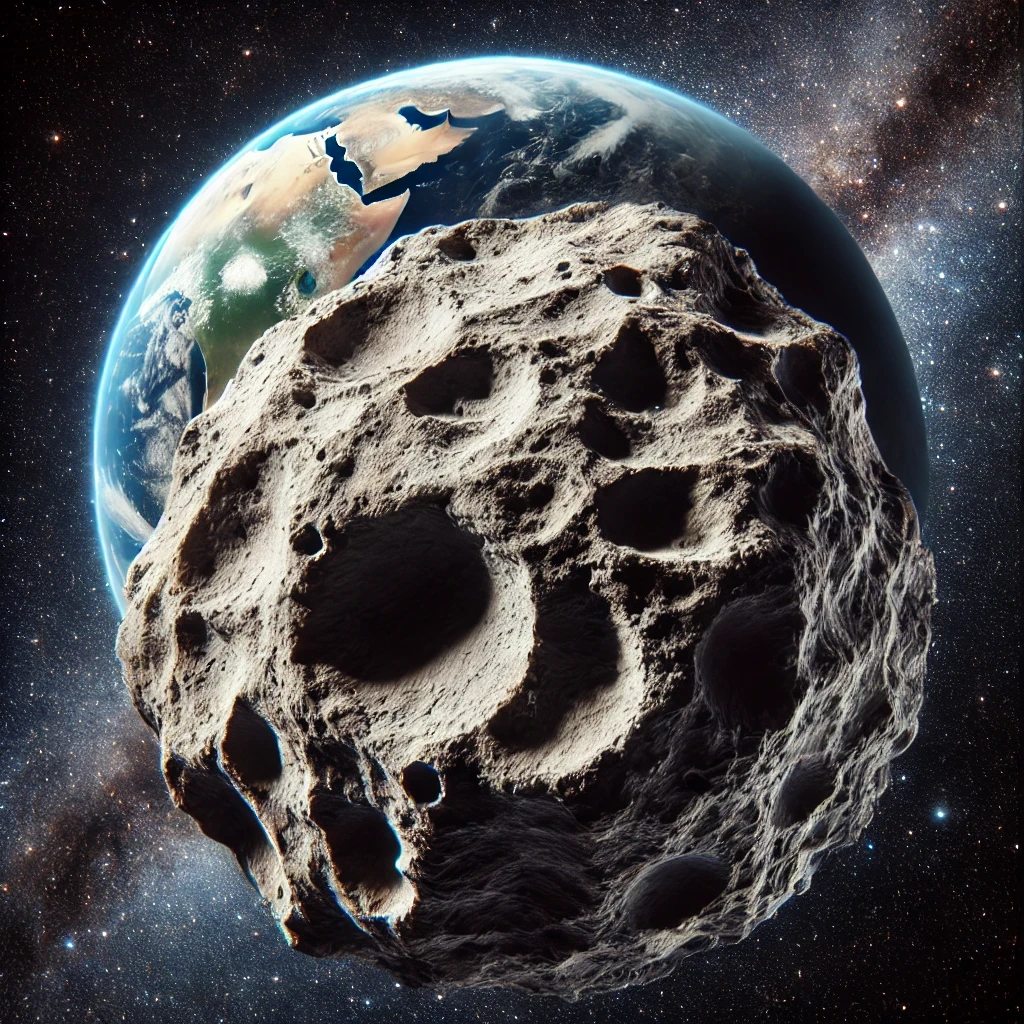
The prospect of an asteroid colliding with Earth captures both scientific curiosity and public concern. While most near-Earth objects (NEOs) pose minimal risk, ongoing research and monitoring by agencies such as NASA and the European Space Agency (ESA) keep us informed about potential future hazards. Drawing on current reports and recent articles, here’s an in-depth look at several asteroids, their potential impact dates, estimated probabilities, and what these numbers really mean for our planet.
Asteroid 2024 YR4: A Closer Look at the 2032 Possibility
Discovered on December 27, 2024, by the Asteroid Terrestrial-impact Last Alert System (ATLAS) in Chile, 2024 YR4 is an Apollo-type near-Earth object measuring roughly 40 to 90 meters in diameter. Early observations sparked concern about a potential impact on December 22, 2032. Recent updates have refined these estimates:
- Probability Estimates:
- NASA calculations now suggest about a 0.27% chance (approximately 1 in 370) of impact.
- The ESA reports a slightly lower probability, around 0.15%.
These figures have been subject to change as further observations narrow down its trajectory. Notably, updated reports indicate that the risk may have significantly decreased as more data become available—a point highlighted in recent articles from The Verge and The Times.
Asteroid 101955 Bennu: A Distant, Long-Term Concern
101955 Bennu is one of the most well-known NEOs, with a diameter of roughly 500 meters. Extensive study, including NASA’s OSIRIS-REx mission, has provided a clearer picture of its orbit. Although not an immediate threat, Bennu carries a long-term potential:
- Key Impact Window: Between 2175 and 2199.
- Most Notable Date: September 24, 2182 is highlighted as the most significant potential encounter date.
- Cumulative Impact Probability: Approximately 0.037% over this period.
Ongoing observations continue to refine Bennu’s orbit, ensuring that even long-dated threats remain under close watch.
Asteroid 99942 Apophis: A Near Miss That Won’t Hit
Once the subject of widespread speculation, 99942 Apophis is now known for its incredibly close approach rather than an actual collision risk. Originally, some calculations had raised alarm about a potential impact:
- Close Approach: On April 13, 2029, Apophis will pass within approximately 31,600 kilometers of Earth—closer than many geostationary satellites.
- Current Status: Detailed observations have since ruled out any collision possibility, making Apophis a prime example of how improved tracking technology can defuse potential threats.
This near miss provides scientists with an excellent opportunity to study gravitational interactions during close encounters without posing an actual danger.
Asteroid (410777) 2009 FD: A Late-Century Consideration
Discovered in 2009, asteroid (410777) 2009 FD is estimated to be between 120 to 180 meters in diameter. Initial assessments once flagged it as a potential risk:
- Potential Impact Date: Early estimates pointed to March 29, 2185 with a probability of about 1 in 710.
- Current Analysis: Thanks to more comprehensive data and an understanding of the Yarkovsky effect (a force acting on rotating bodies in space), subsequent observations have effectively ruled out this impact scenario.
The evolution of 2009 FD’s risk assessment underscores the importance of continuous monitoring and the impact of non-gravitational forces on asteroid trajectories.
Asteroid 2012 FN: The Minimal Threat
Among the smaller NEOs, 2012 FN serves as an example of how size matters:
- Size: Approximately 5 meters in diameter.
- Impact Probability: With an estimated chance of 1 in 4 billion for an impact on March 7, 2113, this asteroid would likely disintegrate in the atmosphere, causing only a brief airburst with minimal ground effects.
Its case illustrates that not all NEOs, especially the very small ones, pose a significant threat.
Current reports and articles confirm that while the notion of an asteroid impact remains a captivating subject, the overall risk to Earth is low. Agencies around the world continue to refine their models and update probabilities as new data emerge. With asteroids like 2024 YR4, Bennu, and Apophis under close observation, the collective efforts of the scientific community help ensure that humanity remains prepared for any potential cosmic hazard.
For more detailed updates, recent articles from The Verge, The Times, and Time offer further insights into how the risks are evolving as our observational capabilities improve.